

Choosing the right stainless steel begins with understanding the environment, not only the price. 201 Stainless Steel Sheets are widely used where moderate corrosion resistance, attractive appearance, and practical forming performance are required. Their lower nickel content helps reduce material costs. Their manganese content supports useful mechanical strength. These qualities make them suitable for kitchen equipment, household appliances, interior panels, decorative trim, furniture, elevators, and light industrial components.
Stainless-steel specialist John C. Lippold offers a valuable reminder: “Material performance depends on both composition and service conditions.” This principle matters when evaluating 201 Stainless Steel Sheets. They can perform well in dry indoor spaces, clean commercial areas, and many decorative applications. However, they are not a universal replacement for 304 stainless steel. High humidity, salt exposure, acidic chemicals, and outdoor pollution may accelerate surface staining. That limitation deserves attention.
In practice, fabricators often value 201 stainless steel for its smooth finish and workable fabrication behavior. It can be cut, bent, pressed, and polished for many products. Still, welding, forming, and surface treatment require controlled procedures. Small process errors may leave scratches, heat marks, or uneven discoloration. Those details affect the finished product.
This article examines what 201 Stainless Steel Sheets are used for, why manufacturers select them, and where their limits become important. The material is cost-effective, but “low cost” should never mean careless selection. Its best application depends on service conditions, maintenance expectations, thickness, finish, and fabrication quality.
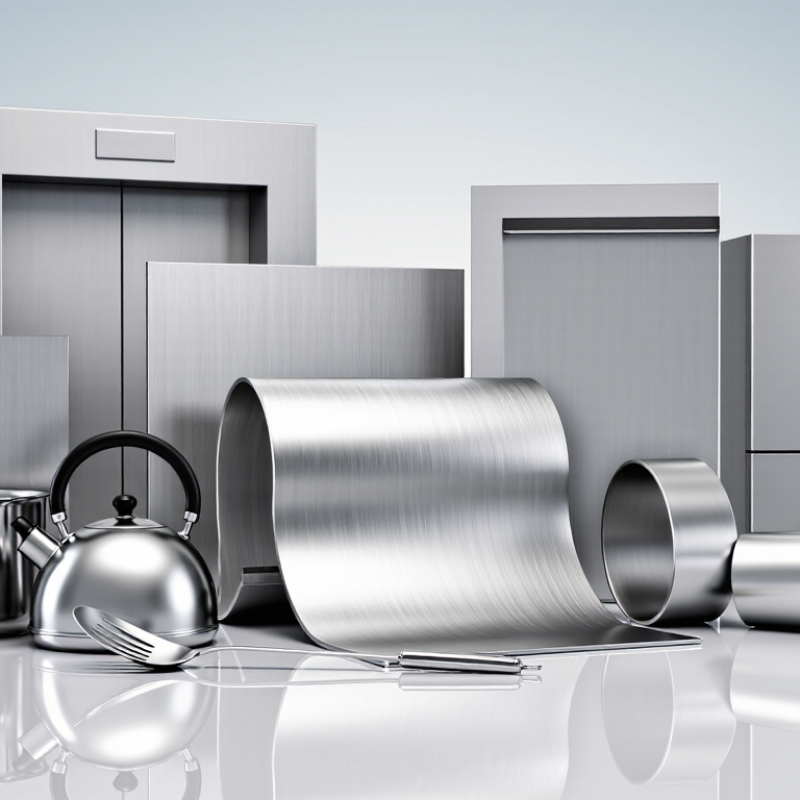
What Is 201 Stainless Steel?
201 stainless steel is an austenitic stainless alloy containing chromium, nickel, manganese, and nitrogen. Its lower nickel content helps reduce material cost, while manganese supports the alloy’s structure and strength. Exact chemistry can vary by standard, so checking the mill certificate matters.
In the annealed condition, 201 stainless steel is generally nonmagnetic. Cold rolling, bending, or pressing can make it slightly magnetic. It also work-hardens quickly, which helps produce strong sheets but may complicate deep forming. Fabricators should use suitable tooling and allow for springback. Small details matter.
What Are 201 Stainless Steel Sheets Used For?
201 sheets are commonly used for indoor wall panels, kitchen equipment, sinks, furniture, decorative trim, elevator interiors, and light-duty enclosures. Their bright surface and useful strength make them practical for visible components. They can also serve in automotive interior parts and architectural fittings where exposure is controlled.
However, 201 stainless steel is not a universal replacement for more corrosion-resistant grades. Moisture, salt, acidic cleaners, and coastal air can cause staining or pitting. That limitation is easy to overlook. For outdoor, marine, or chemically demanding service, engineers should review exposure conditions before selecting the sheet. Surface finish, thickness, welding method, and maintenance also affect actual performance. In real projects, the cheapest sheet may become expensive if cleaning or replacement becomes frequent.
| Data Dimension | Typical Information for 201 Stainless Steel Sheet | Practical Relevance |
|---|---|---|
| Material type | Austenitic chromium-nickel-manganese stainless steel | Offers good formability, toughness, and general corrosion resistance for everyday fabricated products. |
| Typical chemical composition | Chromium: about 16–18%; nickel: about 3.5–5.5%; manganese: up to about 7.5%; carbon: up to about 0.15% | The lower nickel content is partly balanced by manganese, helping reduce material cost while retaining an austenitic structure. |
| Common sheet finishes | Mill finish, brushed finish, and polished decorative finish; surface designations vary by standard and supplier | The finish can support appearance, cleanability, and surface uniformity in interior and light-duty applications. |
| Typical minimum tensile strength | Approximately 685 MPa for annealed material manufactured to common ASTM A240 requirements | Provides adequate strength for many formed panels, covers, housings, and general fabrication components. |
| Typical minimum yield strength | Approximately 292 MPa for annealed material under common ASTM A240 requirements | Helps determine the sheet thickness and forming design needed for a specific load. |
| Formability | Good formability in annealed condition; work hardening occurs during cold forming | Suitable for bending, stamping, pressing, and roll forming, although deep or complex forming may require process control. |
| Weldability | Generally weldable using common stainless-steel welding processes, with procedure selection based on thickness and service conditions | Used for fabricated enclosures, panels, frames, and assemblies; welding discoloration and corrosion protection should be addressed. |
| Corrosion resistance | Good resistance in mild indoor, atmospheric, and low-corrosion environments; generally less resistant than 304 stainless steel in chloride-rich or highly corrosive conditions | Appropriate for many indoor and light-duty applications, but material selection should consider humidity, salt, chemicals, and cleaning agents. |
| Kitchen and catering equipment | Countertop panels, cabinet panels, backsplashes, sinks, shelving, trays, and appliance components | Selected for its clean metallic appearance, formability, and ease of routine cleaning; suitability depends on the food-contact and corrosion requirements. |
| Architectural and decorative products | Interior wall panels, elevator interiors, trim, ceiling panels, column covers, and decorative screens | Provides a modern appearance and can be fabricated into flat, bent, or patterned components. |
| Automotive and transportation components | Interior trim, decorative panels, brackets, covers, and selected non-critical formed parts | Useful where moderate strength, appearance, and formability are needed without exposure to severe corrosive environments. |
| Household and commercial products | Storage cabinets, lockers, shelving, furniture components, washing-machine panels, and appliance housings | Combines a durable surface with relatively easy fabrication for indoor products and equipment. |
| Suitable environment | Indoor areas, dry atmospheric conditions, and applications with limited chemical or salt exposure | Regular cleaning and avoidance of trapped chlorides can help preserve the surface and reduce staining. |
| Applications requiring caution | Marine installations, coastal outdoor structures, strong chemical service, high-chloride process areas, and critical pressure equipment | A more corrosion-resistant or specially qualified grade may be necessary after reviewing the service environment and applicable regulations. |
| Selection checklist | Confirm thickness, temper, surface finish, dimensional tolerance, applicable material standard, forming method, welding procedure, and corrosion conditions | These factors affect the final performance more directly than the grade designation alone. |
Note: Chemical composition and mechanical-property values are representative requirements commonly associated with 201 stainless steel sheet; exact limits depend on the governing material standard, product form, thickness, and condition.